Free AI Detector Review: A Detector That Shows Its Work
Most AI detectors hand you a single percentage and ask you to trust it — then ask you to sign up. This one, a community Space by Lynote on Hugging Face, returns its score with the receipts: a per-sentence breakdown and the statistical signals behind the number. I ran it anonymously to see if the transparency is real.
| Verdict | 8/10 — the most transparent free detector we have tested; a first check, not a judge |
|---|---|
| No sign up? | Yes — no account needed for the basic tool, stated on the page and confirmed in testing |
| Price | Free — a community Space on Hugging Face, no paid tier attached |
| Best for | A quick pre-publish check that tells you exactly which sentences look machine-written |
| Watch out for | Probability, not proof; shared hardware can queue; text is processed server-side |
What is the Free AI Detector?
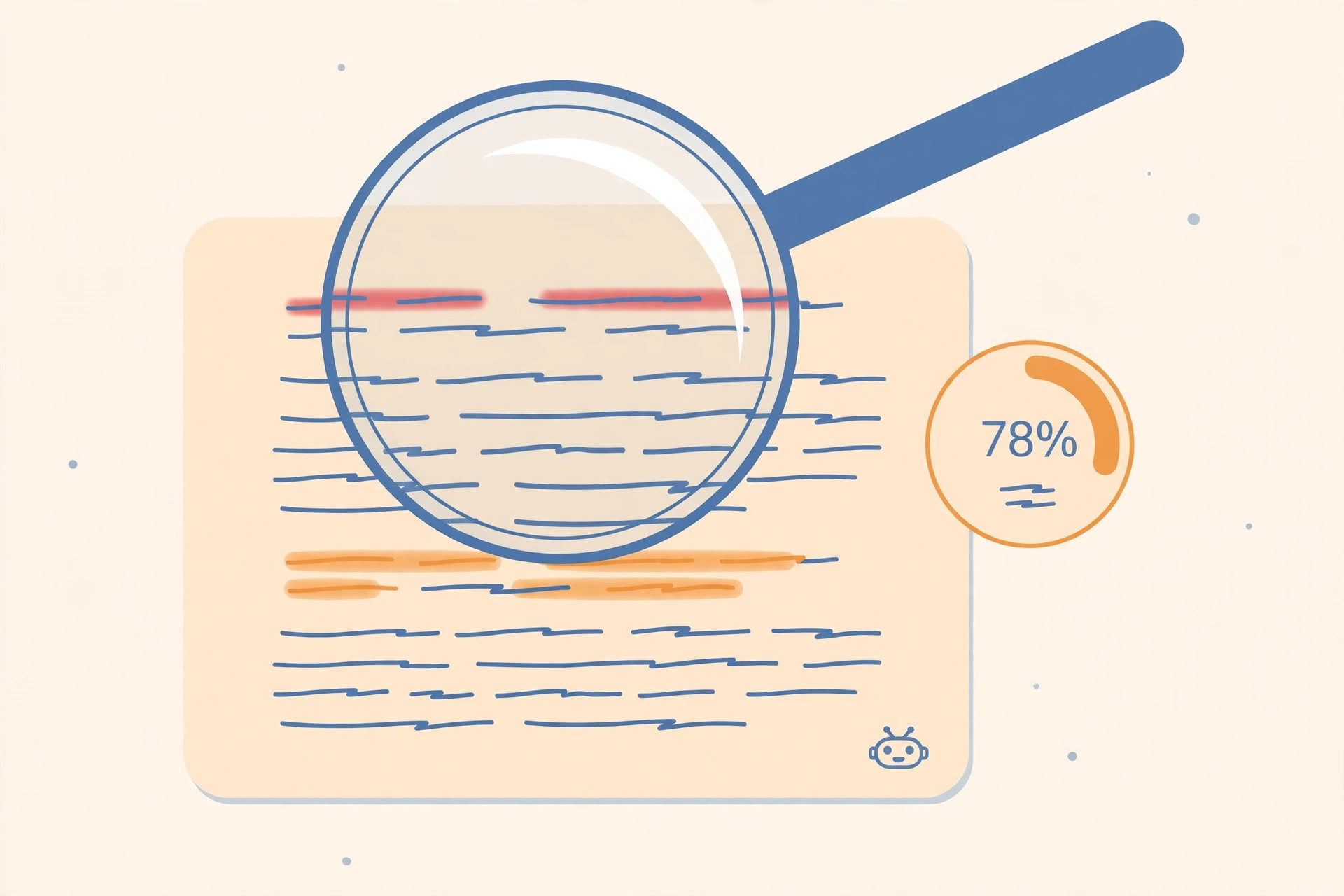
Free AI Detector (huggingface.co/spaces/Lynote/free-ai-detector) estimates how likely a passage is to be AI-generated. Paste text, click Analyze, and in two to three seconds you get a verdict, an AI score, and — the part most detectors skip — a breakdown of the signals that produced it: burstiness, stock-phrase density, repetition rate, vocabulary uniformity. It runs as a public Space on Hugging Face, built by the same maker as the Free AI Humanizer; together they form the check-and-fix pair in our no-signup writing tools category.
The no-signup test
Clean browser, no account. Paste, click, results — the whole flow, with no login prompt at any step and no "free checks remaining" counter. The page states that no sign-up is needed for the basic tool, and nothing in the flow contradicts it. Compare the commercial pattern: detectors from Humaniser to the big academic names give guests a daily ration of checks (30 a day in one case we reviewed), because the ration is the upsell. Here there is nothing to upsell.
The test: an honest "uncertain"
I fed it a deliberately mixed sample — text designed to sit on the fence. The detector came back in two to three seconds with "Uncertain / mixed signal" and an AI score of 46.7%, plus the signal breakdown as structured data and sentence-level highlighting showing which lines pulled the score up.
That fence-sitting answer is, paradoxically, why I trust this tool more than a confident one. Detectors that return a crisp "98% AI" on ambiguous text are performing certainty they don't have. A detector that shows you a middling score, names its signals, and points at the specific sentences is giving you something you can actually act on: edit those lines.
How to use the score properly
Treat the number as a triage tool. The highlighted sentences are almost always the most generic ones — even-length, stock transitions, no specific detail. Rewrite those with a concrete example, a number, an opinion, or run them through the Free AI Humanizer and re-check. What you should never do is treat any detector's output — this one included — as proof about who wrote something. False positives on human text are a documented failure mode of the entire category, and a probability with visible signals is the honest version of the tool.
Free limits: what's actually free
The full basic analysis, with no counter seen in testing. The limits are the usual Space limits: shared hardware can queue at busy times, and the Space can sleep when idle. No word ration, no daily check budget, no premium tier waiting behind the result.
Best for
- Pre-publish sanity checks: two minutes to find the paragraphs that read like a press release from a robot
- Writers who want reasons: the signal breakdown teaches you what "sounds AI" actually means
- Students checking drafts: see the flagged sentences before a stricter institutional tool does
- Pairing with a humanizer: detect, rewrite the flagged lines, re-check — a full loop with no accounts anywhere
Limitations
- Probability, not proof: it can flag human text and miss edited AI text, like every detector
- Not the official score: its number is its own model's estimate, not a Turnitin or GPTZero result — the two can differ
- Server-side processing: your text is processed on Hugging Face's servers; keep sensitive documents out
- Shared hardware: queues and cold starts happen on free Spaces
Free AI Detector vs the alternatives
Against GPTZero and ZeroGPT: the commercial detectors run larger proprietary models and carry the brand names institutions recognize. They are also products — dashboards, histories and higher limits live behind accounts. This detector is the anonymous first check you run before any of that matters.
Against Humaniser's detector: a polished commercial tool with a generous guest ration (30 checks a day, very long texts). If you check text all day, that ration may serve you better. If you check occasionally and want zero relationship with the vendor, the Space wins.
Against its sibling Free AI Humanizer: complementary, not competing. This one finds the problem sentences; that one rewrites them.
FAQ
Is the Free AI Detector really free with no sign up?
Yes. We pasted test text and ran a full analysis in a clean browser with no account and no email. The page states no sign-up is needed for the basic tool, and our test confirms it.
How does the Free AI Detector score text?
It combines statistical signals — burstiness (how much sentence length varies), stock-phrase density, repetition rate and vocabulary uniformity — into an AI probability, then breaks the score down per sentence so you can see which lines drive it.
How accurate is it?
Like every detector, it is a probability estimate, not proof. Our deliberately mixed test text came back as "Uncertain / mixed signal" at 46.7% — an honest answer for an ambiguous sample. Treat any detector score as a prompt to review the flagged sentences, never as a verdict about an author.
How is it different from GPTZero or ZeroGPT?
The big names are commercial products with their own models and, increasingly, account-gated dashboards. This detector is a free community Space: smaller, fully anonymous, and unusually transparent — it shows the signal breakdown behind its score instead of asking you to trust a single number.
What should I do if my text scores high?
Look at which sentences are highlighted — usually the most generic, evenly-paced ones — and rewrite those in your own words, or run them through a humanizer and re-check. Our Free AI Humanizer review covers the no-signup option from the same maker.
Verdict
Free AI Detector does the two things this category usually refuses to do: it works without an account, and it shows its reasoning. The score itself is a mid-tier model's estimate — no better than the category's inherent limits, and it doesn't claim otherwise. As a fast, honest first check that points at the exact sentences to fix, it earns its place next to its sibling humanizer.
8/10. The detector for people who read the footnotes. Run the check here, fix the flagged lines with the Free AI Humanizer, and never hand an email address to a percentage again.
Open Free AI Detector — no sign up →
Tested 2026-10-23 · Providers change their signup policies — we re-verify regularly.